Exploring the World of J. S. Bach: A Traveler's Guide by Robert L. Marshall & Traute M. Marshall
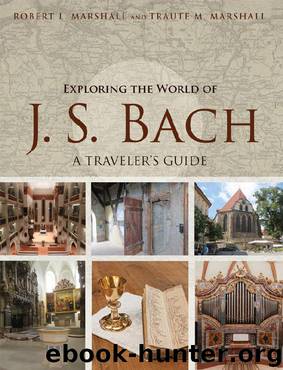
Author:Robert L. Marshall & Traute M. Marshall [Marshall, Robert L.]
Language: eng
Format: epub
Publisher: University of Illinois Press
Published: 2016-07-15T03:00:00+00:00
As far as is known, Bach did not return to Dresden until November 1736, after having been notified that he had finally received the title of court composer he had requested three years earlier (NBR, no. 190). Count Hermann Carl von Keyserlingk (1696–1764), the Russian ambassador to the Dresden court since 1733, personally handed him the letter of appointment, which took effect November 19th. This occasion marks the first documented appearance in the biographical sources of this important Bach patron. It is not known how long they may have known each other by then.
On December 1, according to the Dresdner Nachrichten, “Bach made himself heard from 2 to 4 o’clock on the new organ in the Church of Our Lady (Frauenkirche), in the presence of the Russian Ambassador, von Keyserlingk, and many Persons of Rank, also a large attendance of other persons and artists, with particular admiration, wherefore also His Royal Majesty most graciously named the same, because of his great ability in composing, to be His Majesty’s Composer” (NBR, no. 191). Also in the audience, no doubt, was the organist of St. Sophia’s, Wilhelm Friedemann Bach. Years later Friedemann recalled a performance by his pupil “by the name of Goldberg” before the electress and others in the home of Count Keyserlingk (Falck 1913, 43–44). According to the famous anecdote related by Forkel, Keyserlingk had commissioned the Goldberg Variations from Bach, having once told him “that he should like to have some clavier pieces for his Goldberg … that he might be a little cheered up by them in his sleepless nights” (NBR, p. 464–65). Keyserlingk had reportedly been so impressed with the playing of the ten-year-old Johann Gottlieb Goldberg (1727–56) that he sent him to Leipzig at that time to study with J. S. Bach. Friedemann evidently took over the boy’s instruction later on.
Information about Bach’s two later journeys to the Saxon capital is meager. A poignant letter from the composer dated May 24, 1738, to Sangerhausen town council member Johann Friedrich Klemm (1706–67), in response to disconcerting news relating to his son Johann Gottfried Bernhard (1715–39), reveals in passing that Bach had just returned to Leipzig two days earlier from Dresden. Nothing is known about the purpose or duration of that visit. Bach’s last known visit to Dresden is documented in a series of letters written by his cousin and amanuensis, Johann Elias Bach (1705–55), to different recipients. They reveal that on November 17, 1741, the composer returned from Dresden and that during his stay there he had met with “His Excellency Count von Kayserling [sic] and his domestics … at the house of this great ambassador” (BDOK II, nos. 497–98, 502). The assumption of some connection between this meeting with Keyserlingk and the publication at that very time, the fall of 1741, of the Goldberg Variations, is irresistible but unverifiable.
Download
This site does not store any files on its server. We only index and link to content provided by other sites. Please contact the content providers to delete copyright contents if any and email us, we'll remove relevant links or contents immediately.
The Goal (Off-Campus #4) by Elle Kennedy(13681)
Kathy Andrews Collection by Kathy Andrews(11844)
Diary of a Player by Brad Paisley(7585)
Assassin’s Fate by Robin Hobb(6227)
What Does This Button Do? by Bruce Dickinson(6210)
Big Little Lies by Liane Moriarty(5808)
Altered Sensations by David Pantalony(5107)
Pale Blue Dot by Carl Sagan(5013)
Sticky Fingers by Joe Hagan(4205)
The Death of the Heart by Elizabeth Bowen(3626)
The Heroin Diaries by Nikki Sixx(3554)
Confessions of a Video Vixen by Karrine Steffans(3313)
Beneath These Shadows by Meghan March(3312)
How Music Works by David Byrne(3273)
The Help by Kathryn Stockett(3153)
Jam by Jam (epub)(3096)
Harry Potter 4 - Harry Potter and The Goblet of Fire by J.K.Rowling(3077)
Computational Linguistics and Intelligent Text Processing: 20th International Conference, CICLing 2019 La Rochelle, France, April 7â13, 2019 Revised Selected Papers, Part I by Alexander Gelbukh(2997)
Strange Fascination: David Bowie: The Definitive Story by David Buckley(2874)
